The global agricultural machinery industry continues to face a challenging economic environment in 2026, with weak farmer confidence, rising operating costs and difficult financing conditions affecting equipment sales across several major markets
According to the latest reports from Agrievolution member associations, the recovery remains uneven, with significant differences between countries and machinery segments. While some markets are showing limited improvements, others are experiencing substantial declines in tractor registrations, manufacturing output and new equipment orders.
The situation is particularly difficult in Europe and North America, where pressure on farm profitability is delaying machinery replacement. Meanwhile, Argentina and Turkey are facing contrasting trends between domestic production, sales and international trade.
United Kingdom: recovery loses momentum
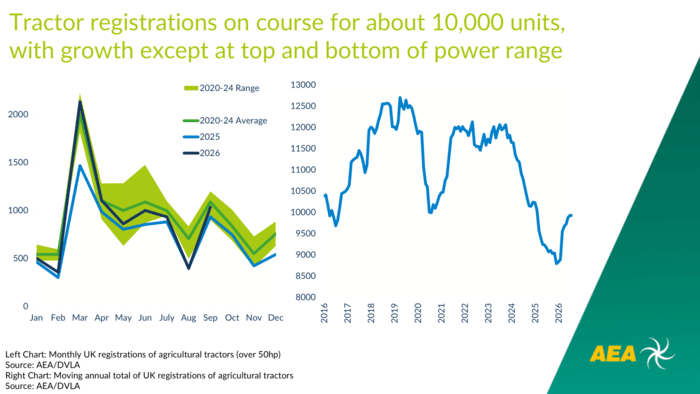
After tractor registrations fell below 8,800 units in 2025, their lowest level since the Second World War, the UK agricultural machinery market showed initial signs of recovery in early 2026. However, growth has progressively weakened.
According to the Agricultural Engineers Association (AEA), tractor registrations increased by more than 30% in the first quarter, but growth slowed to 12% in the second quarter and just 7% between July and September. Full-year registrations are expected to reach approximately 10,000 units, still well below historical levels.
Extreme weather conditions, rising input costs and uncertainty over agricultural policies are affecting farmers’ investment decisions. Arable producers have suffered from poor harvests, while dairy farmers are facing lower milk prices and higher feed costs.
Telehandlers and agricultural implements have performed relatively better, although their growth has also slowed. A return to normal market conditions is expected to be gradual.
United States: high costs weigh on machinery investment
The US agricultural machinery market remains under significant pressure as declining farm profitability limits investment in new equipment.
According to the Association of Equipment Manufacturers (AEM), US net farm income is projected to fall from $176.7 billion in 2025 to $145.9 billion in 2026, a decline of 17.4%. At the same time, production expenses are expected to reach $473.7 billion, while agricultural debt continues to rise.
The combination of elevated machinery prices, fertiliser costs and financing expenses is particularly affecting large crop producers.
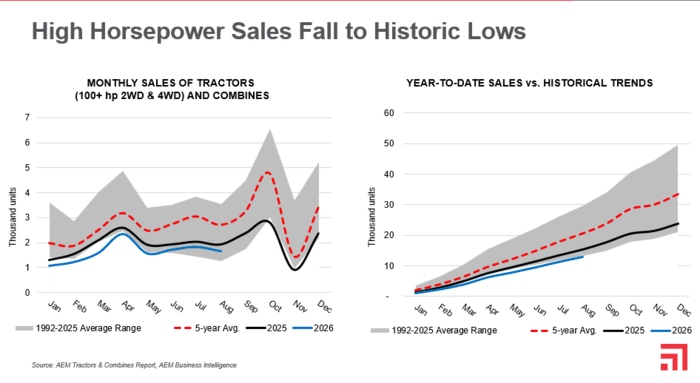
Sales of high-horsepower tractors, four-wheel-drive tractors and combine harvesters remain weak, as farmers extend replacement cycles and increasingly turn to used machinery.
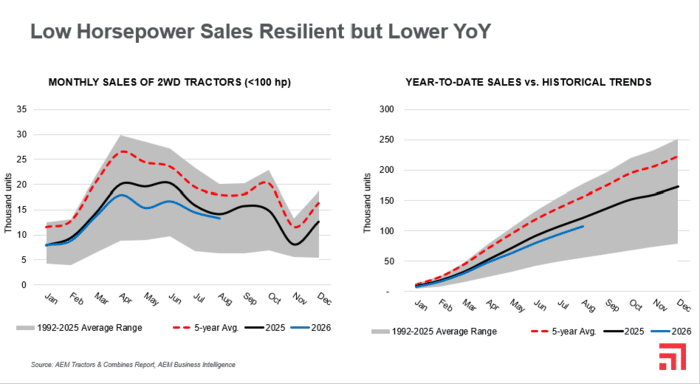
However, demand for tractors below 100 hp has proved more resilient, supported by livestock operations, smaller farms and non-agricultural applications.
The livestock sector, particularly cattle farming, continues to benefit from relatively favourable market conditions, supporting demand for utility tractors, haymaking and forage equipment.
France: falling orders despite higher turnover
France is experiencing another difficult year for agriculture, with drought and repeated heatwaves severely affecting crop yields and farm profitability.
According to AXEMA, maize and sunflower yields are expected to decline by around 25% compared with the five-year average, while sugar beet and potato yields are also forecast to fall significantly.
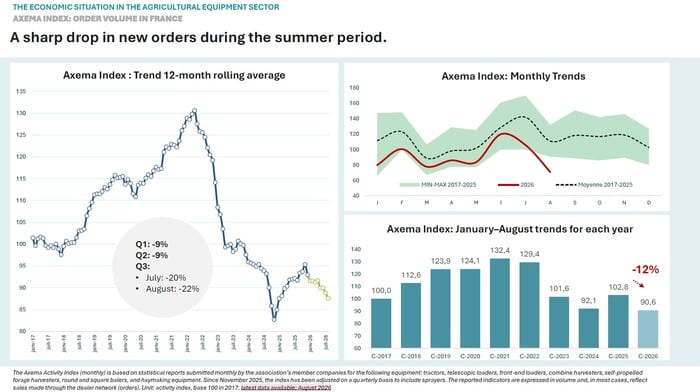
These conditions are directly affecting agricultural machinery demand. New equipment orders declined by 20% in July and 22% in August, potentially pushing the order index to its lowest level since its introduction in 2017.
Combine harvesters, round balers and sprayers are among the most affected categories.
Despite the decline in orders, manufacturers’ turnover increased by 5% during the first seven months of 2026, largely supported by exports. This apparent contradiction reflects the time lag between machinery orders and deliveries.
The second-hand market is also gaining importance, particularly for tractors and combine harvesters, as farmers postpone investments in new equipment.
Italy: tractor registrations decline as investment slows
The Italian agricultural machinery market also lost momentum during 2026, following a positive start supported by government incentives.
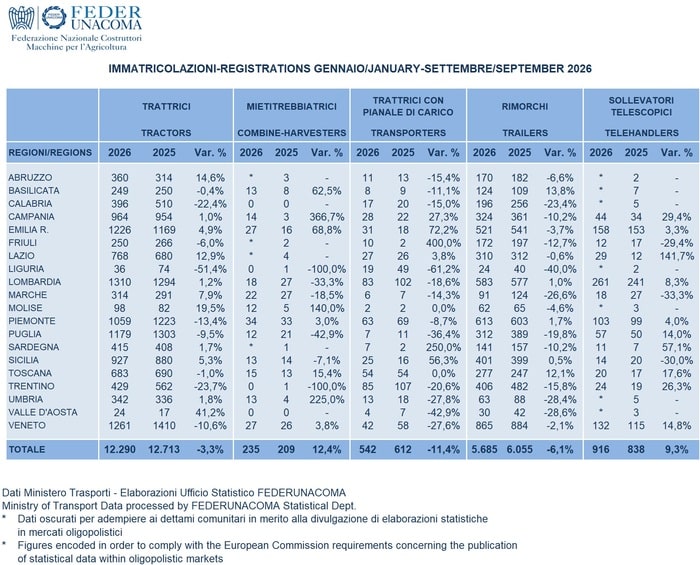
According to FederUnacoma, tractor registrations reached 12,290 units between January and September, down 3.3% compared with the same period in 2025.
The deterioration was particularly evident in the third quarter, when tractor sales fell by 13.8%, combine harvesters by 37.5% and telescopic handlers by 16.2%.
Over the first nine months, however, combine harvesters remained in positive territory, with 235 registrations (+12.4%), while telescopic handlers increased by 9.3% to 916 units.
FederUnacoma emphasises the importance of public incentives in supporting machinery renewal and technological innovation.
The upcoming EIMA International exhibition in Bologna, scheduled for November 10–14, will provide an important opportunity to assess market prospects and discuss future support measures for the sector.
Argentina: domestic production collapses despite stable sales
Argentina presents one of the most striking contrasts between agricultural machinery manufacturing and market demand.
According to CAFMA, domestic agricultural machinery production fell by 46.6% year-on-year in July 2026, bringing the January–July decline to 30.5%.
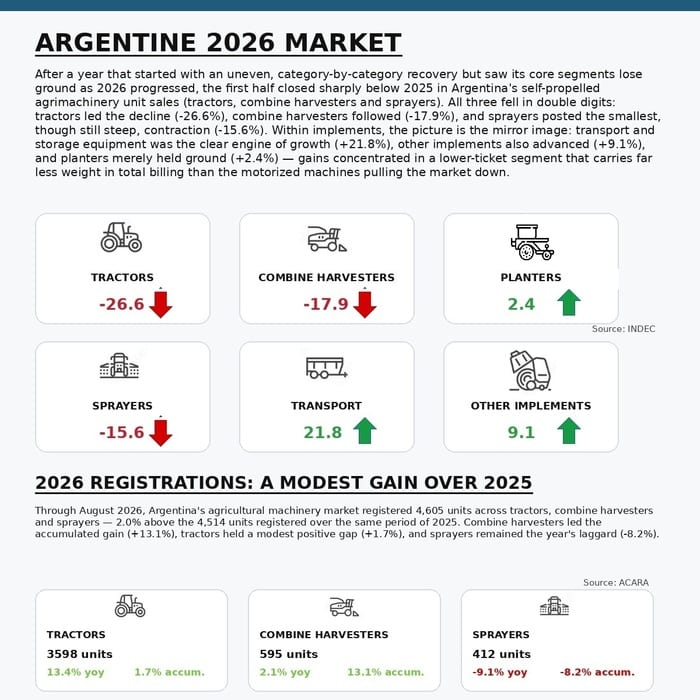
However, machinery registrations remained slightly positive, reaching 4,605 units through August, up 2% compared with the previous year.
Combine harvesters recorded the strongest growth (+13.1%), while tractor registrations increased by 1.7%.
Imports are playing an increasingly important role, with China expanding its share of agricultural machinery import value from 13.3% to 19%. In the tractor segment, China’s share reached 39.1%.
The widening gap between domestic production and equipment registrations highlights the difficulties facing local manufacturers, despite relatively stable commercial demand.
Japan: rice market uncertainty affects machinery demand
In Japan, agricultural machinery investment remains closely linked to rice production policies and market prices.
According to the Japan Agricultural Machinery Manufacturers Association (JAMMA), rice shortages and rising prices in 2025 temporarily boosted farmers’ incomes and encouraged machinery purchases.
However, increased rice production and the release of government reserves have contributed to an oversupply situation in 2026, putting downward pressure on prices.
The Japanese government has consequently adjusted its agricultural policies, focusing on production aligned with demand, improved market forecasting and more effective stock management.
For machinery manufacturers, the key concern is whether declining rice prices will reduce farmers’ purchasing power and lead to weaker equipment demand.
Turkey: tractor market contracts sharply
Turkey is experiencing one of the most severe contractions among the markets covered by Agrievolution.
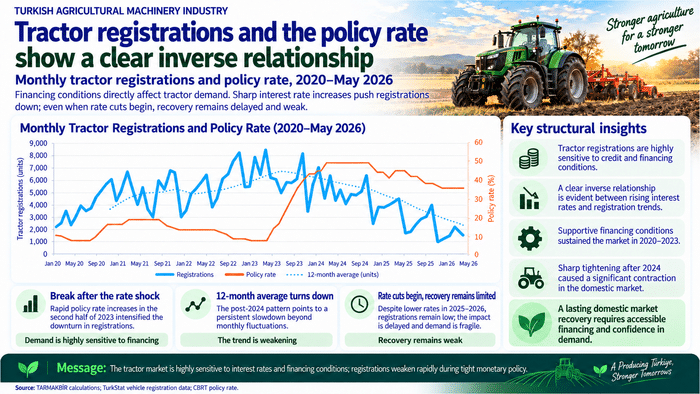
According to TARMAKBIR, tractor registrations fell by 49.5% during the January–July 2026 period, reaching just 12,867 units.
Domestic tractor production also declined significantly, with 23,031 units manufactured between January and August, down 26.2% year-on-year.
High interest rates, restricted access to credit and rising agricultural input costs remain the main obstacles to machinery investment.
Nevertheless, exports have provided some support to the industry. During the first half of 2026, agricultural machinery exports increased by 13.6% to $793 million, helping offset part of the domestic market weakness.
TARMAKBIR currently estimates that the Turkish tractor market could close 2026 at between 24,000 and 26,000 units, with a possible improvement if financing conditions become more favourable.
A global recovery still dependent on farm profitability
The reports collected by Agrievolution reveal a common challenge across the international agricultural machinery industry: farmers remain cautious about investing in new equipment.
Although the underlying causes vary between countries, high production costs, uncertain agricultural incomes, expensive financing and geopolitical instability are affecting purchasing decisions in most major markets.
Manufacturers are responding to these conditions by relying more heavily on exports, adapting their product portfolios and strengthening their presence in markets showing greater resilience.
For the remainder of 2026 and into 2027, the outlook will depend largely on improvements in farm profitability, access to credit and the stability of agricultural commodity markets.
While demand for certain machinery categories remains relatively robust, the latest Agrievolution findings suggest that a sustained global recovery in agricultural equipment sales is still some way off.