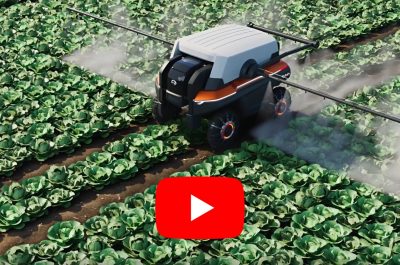
Kubota is scheduled to exhibit the “Type V” and “Type S” concept models of its versatile platform robots for the future at the Future City pavilion, during the upcoming Expo 2025 in Osaka, Japan, which Kubota supports as a platinum partner. The Type V model will be making its world debut at that time.

“Planetary conscious” expresses a state in which a prosperous society and the sustainability of the global environment are simultaneously achieved within the “planetary boundaries,” which are the limits of the Earth.

At the Future City pavilion, Kubota is in charge of the Food and Agriculture sector, and will showcase the future of food and agriculture in the Society 5.0. To realize the exhibition theme of “Planetary conscious Food and Agriculture that is friendly to the earth and people and leads to the future,” Kubota believes it is essential to establish new low-environmental-impact farming methods, including fully automated and data-driven, precision agriculture. Kubota will be exhibiting Versatile Platform Robots for the future as a key technology in achieving the company’s vision for the future of agriculture.

The concept behind versatile platform robots

These platform robots for the future are designed to perform a range tasks required in agriculture and other fields with fully autonomous and no need for human intervention. Using a diverse range of equipment and implements, they are able to perform data-driven, precision farming, handle the many remaining manual tasks, and even carry out civil engineering and construction work with fully autonomous. These next-generation platform robots are designed to safeguard the future of our food supply in response to the declining number of agricultural workers.

Multiple autonomously operating Type: V and Type: S units working in coordination with one another are able to perform tasks efficiently in a variety of fields.

Model type V
Model type S
Features of model V

V platform robots are completely autonomous and surpass the conventional boundaries of agricultural machinery.  The height and width of the vehicle bodies are transformable (adjustable) to match the spacing between crops, their growth conditions, and the specific task. Additionally, a single unit may be used for a wide range of applications due to the ability to automatically replacing the implement to best suit the operation at hand. For example, in rice farming, these robots are able to handle tilling*1, intermediate management*2, pest control*3, and harvesting, which have traditionally been performed by separate machines such as tractors and combines. They can be used for vegetables and a variety of other crops, as well as for a broad range of non-agricultural tasks.

*1. Digging and tilling the soil prior to sowing or planting rice

*2. Weeding, thinning, and moving soil between the time of sowing or planting and harvesting

*3. Preventing pests, diseases, weeds, and other harmful elements

Features of model S

By flexibly bending and extending their four legs, they are able to maintain a level position even on hilly slopes and rugged terrain, such as in orchards, enabling efficient cargo transportation and highly precise management tasks.

The platform has a wide variety of potential by installing attachments designed for a broad range of specific tasks. Development of robot arms and various other attachments in cooperation with external partners will enable Kubota to expand the technology beyond the boundaries of both cargo transportation and agriculture.

The KATR, the foundation of model type S, was exhibited at CES 2025, the world’s largest technology trade show, and it was named Best of Innovation in the Industrial Equipment and Machinery product category of the CES Innovation Awards 2025 program.

Dream tractor

Kubota showcased the “dream tractor” at the Japan World Exposition held in Osaka in 1970. At the time, its concept and many of its innovative features were considered groundbreaking, and over the years, these technologies were gradually put into practical use. Now, many of them have become standard in modern tractors. In the near future, type V and type S models may become a common sight in fields.

In the pavilion , videos and games will be streamed on large screens, vividly depicting food and agriculture in a planetary-conscious future, when type V and type S models are playing active roles.

Expo 2025 runs from April 13 until October 13, 2025 in Osaka, Japan

Highlights

MF 7S MARK 2, the future of Massey Ferguson tractors

Massey Ferguson unveils its new mid-to-high horsepower tractor range. Among the contenders for Tractor of the Year 2027, the new line-up comprises six models and introduces a host of significant updates. With EIMA International just around the corner, major announcements from the tractor industry ar...

McCormick unveils new X8, X7 and X6 tractors for EIMA 2026

McCormick is set to introduce major updates across its tractor range at EIMA 2026, led by the new 340 hp X8.634 VT-Drive and the 271 hp X7.627 VT-Drive. The line-up will also include the X7.624 Digital Edition and two new X6 models, highlighting advances in powertrain technology, operator comfort, p...

Related articles

Real-time optimizing berry harvest

Oxbo is unveiling AutoHarvest, an integrated machine-learning technology bringing real-time harvest optimization to berry growers. Designed for Oxbo berry harvesters, AutoHarvest continuously analyzes harvesting conditions and automatically adjusts machine functions, helping achieve consistent resul...

Fendt tractors operate autonomously

Guidance systems and numerous assistance systems have become established in agriculture. By combining various assistance functions, Fendt tractors achieve Level 3 autonomy today. With the “OutRun Grain Cart” and “OutRun Tillage” retrofit kits, Fendt tractors can be used autonomously for grain harves...