AI-powered robot harvests fruit
The Nanovel AI-powered autonomous fruit-harvesting robot is designed to pick citrus fruit for fresh markets from large trees with dense foliage. It represents a breakthrough in fruit-harvesting technology. Nanovel, an Israeli AgTech startup, has unveiled an AI-powered autonomous fruit-harvesting robot, capable of picking tree fruit for the fresh market. The robot offers a solution to […]
By Redazione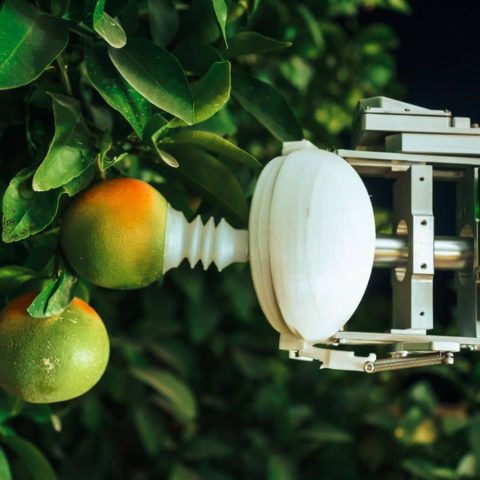
The Nanovel AI-powered autonomous fruit-harvesting robot is designed to pick citrus fruit for fresh markets from large trees with dense foliage. It represents a breakthrough in fruit-harvesting technology.
Nanovel, an Israeli AgTech startup, has unveiled an AI-powered autonomous fruit-harvesting robot, capable of picking tree fruit for the fresh market. The robot offers a solution to growers dealing with farm labor shortage and rapidly increasing costs. According to a survey conducted by Western Growers organization in the US, profitability and labor availability were ranked as the top two challenges faced by specialty crop growers.
The value of Nanovel’s technology was recognized by the California Citrus Research Board (CRB). The CRB and Nanovel signed a non-dilutive funding agreement of $900,000, which includes the delivery of the robot to the CRB after a series of field trials in California which are set to start next year.
Nanovel was established in 2018 by the company’s CEO Isaac Mazor, an entrepreneur with over 30 years of experience in technology innovation, AI, computer vision, and robotics.
The Nanovel AI-powered autonomous fruit-harvesting robot is the world’s first-of-its-kind system designed to pick citrus fruit for fresh market in dense foliage. The system features a multi-arm platform, which will initially be towed by a tractor. Future versions are planned to include an internal driving unit and autonomous navigation capabilities. The robot’s telescopic arms are equipped with edge computing, advanced vision systems, and AI to identify, assess, and selectively pick fruit with precision that meets fresh market quality standards. In the first phase, the robot is planned to harvest oranges, with later expansion to other types of citrus, the most widely cultivated fruit globally. The company’s crop roadmap includes lemons, grapefruits, avocados, mangoes, peaches, and nectarines.
Each arm of the robot uses a patented end-effector with a vacuum gripper to cradle the fruit and then trim the stems using cutters without damaging the fruit. The fruit is then transported via conveyor belts to bins. The robot uses advanced edge computing to deliver real-time, AI-driven data necessary for fruit picking. This is a key component of Nanovel’s technology, allowing the robot to pick fruit in dense foliage.
Nanovel robots are useful in the United States, where orange harvesting occurs year-round, allowing for high capital utilization. With this in mind, the California Citrus Research Board (CRB) has signed a non-dilutive funding agreement with Nanovel, which includes the delivery of a robot after a series of field trials in California, totaling $900,000. The field trials are set to start in the spring of 2025, and will be conducted in cooperation with leading citrus growers.

A key benefit of the Nanovel AI-powered autonomous fruit-harvesting robot is its ability to significantly reduce labor costs and minimize the logistical challenges associated with hiring seasonal workers. Studies show that manual harvesting is the single most labor-intensive task for fruit farmers, accounting for up to 50% of annual cultural costs in the citrus industry in developed countries. Additionally, the system can operate day and night, optimizing productivity and ensuring crops are picked at optimal times, potentially improving fruit quality and market value.
Furthermore, automating the harvesting process helps avoid the dangerous task of laborers picking fruit while on ladders. This alone supports a huge improvement in worker safety and reduces the risk of accidents and injuries. Additionally, the real-time collection of harvest data by the system, delivers invaluable insights that can be used for packing and marketing activities and can also provide important agronomic insights to growers.
Nanovel will showcase the AI-powered autonomous fruit harvesting robot at the World Agri-Tech Innovation Summit, which will take place in London between September 30 and October 1.
“Our mission is to secure the affordability of fresh fruit through autonomous harvesting,” said Isaac Mazor. “Our goal is to deploy Nanovel’s solution into major global citrus markets, particularly in the US and Southern European countries like Spain and Italy. We aim to set a new standard for fresh market harvesting, ensuring high quality and economic viability for growers.”