Big Data meets Machine Learning
From the Internet of Things (IOT), over cloud solutions and Big Data to mobile apps: advancing digitalization enables services and solutions for the off-highway markets to be designed more individually, more consistently and more transparently. Systems & Components, held within the agricultural machinery exhibition, Agritechnica, in Hanover, Germany, technology providers will be presenting a wide […]

From the Internet of Things (IOT), over cloud solutions and Big Data to mobile apps: advancing digitalization enables services and solutions for the off-highway markets to be designed more individually, more consistently and more transparently.
Systems & Components, held within the agricultural machinery exhibition, Agritechnica, in Hanover, Germany, technology providers will be presenting a wide range of smart solutions that can be used to increase the efficiency, reliability, safety and comfort of mobile machinery.
Mobile machinery, especially that equipped with modern assistance systems, has access to large amounts of relevant data across numerous applications . This means there is plenty of potential for so called “Big Data” analyses, where the processing of large data sets can provide meaningful insights. The question is, what can usefully be done with all this information? The added value that can currently be delivered depends strongly on the application experience of the technology provider.
“It is important for us not to display arbitrary data just because a particular sensor happens to be installed. We want to provide the customers with useful information that they can use to manage their machinery fleet and thus run it as economically as possible,” explains Wolfgang Boos, Liebherr product manager.
Two questions in particular are at the center of discussions at Systems & Components when it comes to use cases such as digital fleet management and machine-to-machine communication for agricultural and construction machinery: How can users benefit from Big Data in practice? And how can artificial intelligence be meaningfully integrated into off-highway machines? Using modular, open systems, like those found at the trade fair , vehicles and their subsystems are networked with the cloud into the “Internet of Things”, and a range of functions can be individually configured. Original Equipment Manufacturers (OEMs) can design their own applications based on the technology provider’s validated software packages, and machine rental companies can create new business models.
Display work progress at the touch of a button
Access to smart sensor data over a telematics solution enables a whole range of intelligent functions, with fleet management and remote diagnostics being typical entry scenarios in the off-highway sector. Fleet management solutions track the position of the machinery fleet automatically, enabling the operator to simply and easily locate each machine. A geographical area, such as a construction site or a field, can be defined (geo-fencing) and all relevant data within this area is collected together. From this data, for example, the time period, the number of operating hours, the type of operation, the fuel consumed and the CO2 emissions, contracting invoices or harvesting reports can be automatically generated. The telematics units used in the agricultural machines are linked to ISOBUS, over which they can access detailed machine data, and then transmit it to the fleet management system.
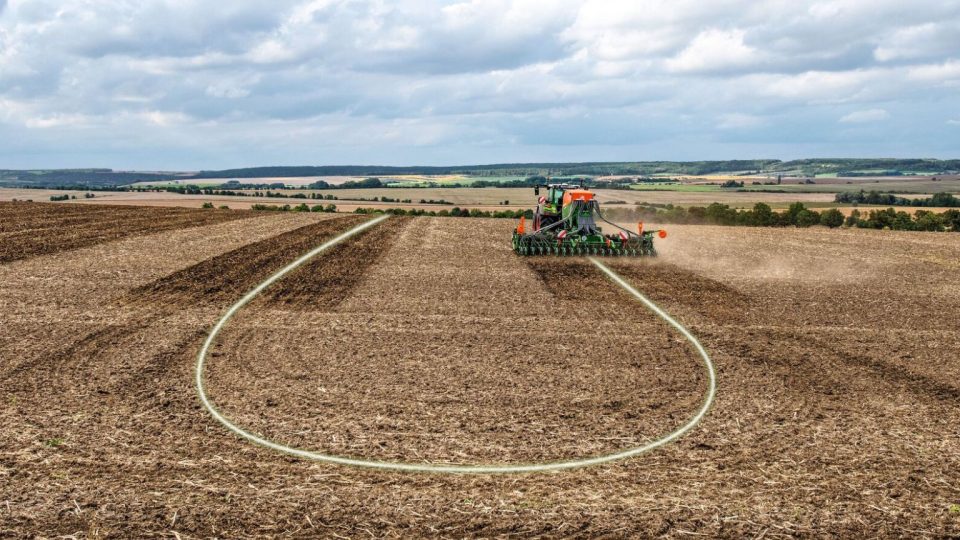
Precision farming functions can be optimized in a similar way. Data collected over time, such as nitrogen sensors or cameras mounted on a tractor, is coupled with satellite pictures and analyzed to determine the optimal distribution of fertilizers or crop protection agents on the field. This distribution data is then communicated back to the implement, which can then precisely apply the inputs only where they are needed, not only to avoid overlapping but also according to the needs of each individual plant, saving the farmer significant costs.
As these functions become more complex and especially as they become more autonomous, not only data is needed but also corresponding data processing.
“Powerful computing is essential for autonomy,” says Stefan Taxer, product manager for mobile automation at B&R. Providing the necessary on-board computing power for data analysis and autonomous processes, the automation specialists exhibiting in Hanover will present powerful “edge” controllers that perform all the necessary real-time, local computations. Data is preprocessed, aggregated and then transmitted to the central management function in the cloud across a network. However, to ensure that the machine must never wait for a potentially unreliable communication channel, all of the second-to-second decisions, where to turn, when to switch on the implement, and so on, are taken on the mobile machine by the edge controller. These control modules have been designed to work in the harshest of environments, where vibrations, extreme temperatures, moisture and dirt place the highest demands on robustness.
Detect problems before the failure occurs
The collected real-time data can also be used for predictive and remote maintenance. Systems & Components exhibitors are further expanding their offerings of data-driven digital services to support customers in optimizing the performance and maintenance of their machines. Sensor clusters are mounted on plant components such as pumps, gearboxes, compressors or drives, collecting vibration and temperature data. This data is transmitted wirelessly to a gateway and then from there securely to the cloud, where Big Data analysis tools collect, process and evaluate these measurements over the long-term using machine learning algorithms that use the detailed component knowledge of the design engineers.
Using this information, maintenance personnel receive reliable warnings of emerging defects and can thus react in time to prevent the machine from failing, with a precise diagnosis allowing the necessary spare parts to be ordered in advance. The information obtained through monitoring and diagnostics also offers great potential to engineers, as machinery design can be continuously optimized based on real load and usage data.
The road to fully automated working machinery
The use of the Industrial Internet of Things in the off-highway sectors is still in its infancy. Nevertheless, the networked components being shown at Systems & Components from November 12 to 18, are leading to a future of lower manufacturing costs, more efficient project implementation and faster completion. The data collected from these and future applications will be used to build “digital twins”, high performance simulations that enable virtual testing and optimization of new systems. On the path towards ever increasing autonomy of mobile machinery, where such approaches are essential, exhibitors at the exhibition center will be accompanying customers from the very beginning in the development of market-relevant solutions.