CLAAS celebrates 30 years of VARIANT round balers with anniversary editions and special financing
Three decades after introducing its first in-house developed variable-chamber round baler, CLAAS marks a major milestone in baling technology. The anniversary celebrations include two commemorative machines, special financing offers and dedicated anniversary branding for the VARIANT and CEREX ranges manufactured at Metz-Woippy, France

CLAAS is celebrating 30 years of its VARIANT variable-chamber round balers, a product family that has played a significant role in the development of the company’s harvesting equipment portfolio. First introduced in 1996, the VARIANT range has evolved through five generations, incorporating technological advances designed to improve bale density, productivity and operating efficiency.
The anniversary also highlights the importance of the CLAAS production facility in Metz-Woippy, France, which has been manufacturing balers for 65 years and remains a key centre for the development and production of the company’s baling equipment.
From the first CLAAS baler to the VARIANT series
CLAAS has a long history in baling technology, dating back to 1931 with the introduction of the PRESS-BU-BI, its first commercially produced baler. The company’s expertise in crop handling began even earlier, with the development of its patented knotter technology.
Over the decades, CLAAS has manufactured and marketed more than 400,000 balers worldwide, establishing itself as one of the major players in this agricultural machinery segment.
An important milestone came in 1958, when CLAAS began establishing its production facility in Metz-Woippy, in the Lorraine region of France. The plant, founded by Helmut Claas, became the company’s first manufacturing site outside Germany. Baler production started there in 1961, while product development activities were transferred from Harsewinkel to Metz in 1994.
Two years later, the French facility played a central role in the launch of the VARIANT 100, the first variable-chamber round baler developed entirely in-house by CLAAS.
Thirty years of technological development
The introduction of the VARIANT 100 in 1996 marked a significant step forward for CLAAS in the variable-diameter round baler segment. The company had previously offered the VARIANT 16, an OEM-sourced machine, but the new series introduced a proprietary technical architecture.
Among its distinguishing features was the active bale starting and driving system using the rotor, designed to ensure reliable bale formation even in challenging crop conditions while achieving high bale densities.
The machine also featured a hydraulic soft-core function, allowing operators to adjust the bale structure to facilitate further drying of crops such as hay. Its 2.10-metre pick-up was another important feature, offering what CLAAS described as the widest working width available on the market at the time. Over five generations, the VARIANT family has progressively incorporated new technologies aimed at improving performance and ease of operation.
Major developments have included automatic tying initiation, the hydraulically lowerable PRO cutting floor, the 360-degree rotor, XW net wrapping with improved edge coverage, SMART DENSITY bale pressure management and the MULTIFLOW HD pick-up. These innovations have helped the VARIANT series adapt to the changing requirements of farmers and agricultural contractors, particularly in terms of throughput, bale quality and operational reliability.
CEREX 700 expands the variable-chamber range
The latest chapter in CLAAS’s baling technology development began in 2025 with the introduction of the CEREX 700 series.
Developed as a completely new product platform, the CEREX 700 complements the VARIANT 500 range and targets operators requiring higher throughput and increased bale density, while optimising power requirements.
Together, the two product families represent CLAAS’s current offering in the variable-chamber round baler segment, combining established technologies with the latest developments in crop processing and bale formation.
According to CLAAS, approximately 30,000 variable-diameter round balers have been manufactured by the company over the past three decades, with VARIANT models accounting for the majority.
“Balers are one of the strongest foundations of our company,” said Dr Martin von Hoyningen-Huene, Chief Technology Officer of the CLAAS Group.
“Today, we can look back with pride on 30,000 variable-diameter round balers built, the majority of which are VARIANT models. Our current range, comprising the CEREX 700 and VARIANT 500, is built on this extensive experience – the strongest range of variable-diameter round balers we have ever had at CLAAS.”
Two anniversary models and special financing for 2027
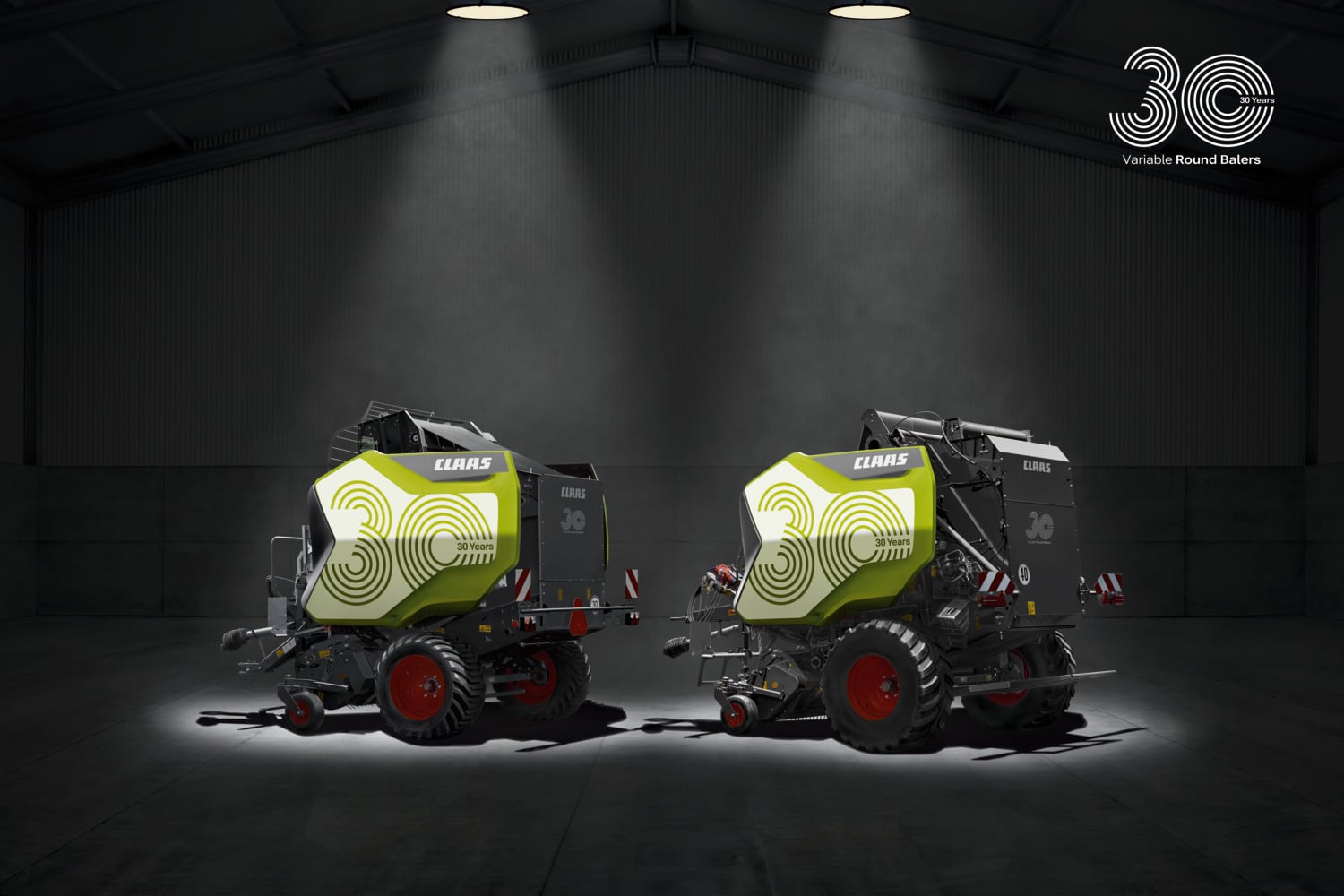
To celebrate the 30th anniversary, CLAAS has prepared two commemorative machines featuring a special design inspired by round bales of different diameters, reflecting the technology behind variable-chamber baling.
One of the anniversary machines will be displayed for a year at the visitor centre in Metz-Woippy, while the second will be exhibited at the CLAAS Technoparc in Harsewinkel, Germany. The celebrations will also extend to customers through a dedicated financing programme covering the 2027 financial and product year.
Starting in October 2026, buyers of VARIANT and CEREX round balers will be able to benefit from promotional financing conditions, including a special interest rate and a 30-month repayment period, directly linked to the anniversary milestone. The specific financing conditions will vary according to the sales region. In addition, all VARIANT and CEREX models manufactured at Metz-Woippy during the twelve-month anniversary period will feature dedicated commemorative decals on their side panels and tailgates.
Metz-Woippy remains central to CLAAS baler production
Beyond the anniversary itself, the celebrations underline the strategic importance of the Metz-Woippy facility within the CLAAS manufacturing network. With 65 years of baler production and more than three decades of dedicated product development activities, the French plant has become a centre of expertise for the company’s baling technologies.
The evolution from the original VARIANT 100 to today’s VARIANT 500 and CEREX 700 illustrates how CLAAS has progressively refined its variable-chamber baler concept to meet growing demands for productivity, bale density and efficient power utilisation.
As the company celebrates three decades of VARIANT technology, its latest generation of round balers provides the foundation for further developments in one of CLAAS’s longest-established product segments.